

 Digital Transformation

 Technical Strategy Services
 Foundational Strategy Services
 Information Architecture
 Content Experience & Strategy
 Bitrix24 For Business Automation
 Software Development
 Custom Application Development
 Mobile Application Development
 E-commerce Development
 Website Development
 UI/UX Audit of Site Usability
 Website Technical Support
 Digital Marketing
 Marketing Automation Services
 Search Engine Optimization (SEO)
 Content Marketing & Copywriting
 Paid Search & PPC Management
 Social Media Marketing
 Email Marketing Services
 Research
 Brand Health Research
 Analysis of Brand Competitors
 Target Audience Analysis
 Testing of Design and Concept
 Analytics Setup & Data Analysis
 Foundational Strategy Services
 Information Architecture
 Content Experience & Strategy
 Bitrix24 For Business Automation
 Custom Application Development
 Mobile Application Development
 E-commerce Development
 Website Development
 UI/UX Audit of Site Usability
 Website Technical Support
 Marketing Automation Services
 Search Engine Optimization (SEO)
 Content Marketing & Copywriting
 Paid Search & PPC Management
 Social Media Marketing
 Email Marketing Services
 Brand Health Research
 Analysis of Brand Competitors
 Target Audience Analysis
 Testing of Design and Concept
 Analytics Setup & Data Analysis

 Expertise Overview
 Digital Transformation
 Software Development
 Digital Marketing
 Research
 Products Overview
 Solutions Overview
 Real Estate CRM
 Hospitals CRM & Bookings
 Retail Digital Transformation
 Marketing Automation
 Tasks & Projects
 HR Automation
How to Choose a Bitrix24 Partner in Dubai: 7 Questions to Ask First
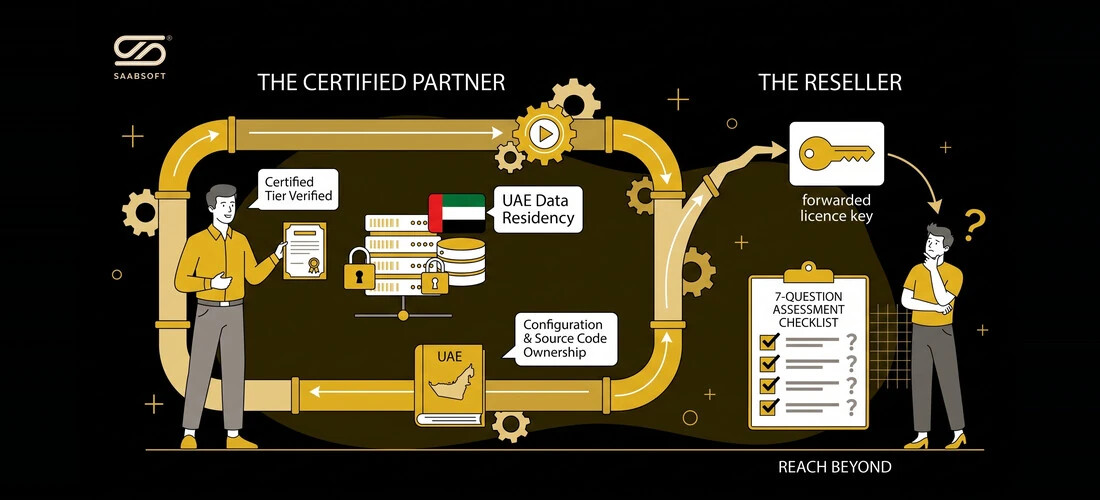
Seven questions to ask before hiring a Bitrix24 partner in Dubai, from certification tier and data residency to who owns your configuration.
Bitrix24 is sold directly by the vendor, which means anyone can resell it. The licence costs the same whoever you buy it from, so the price on the invoice tells you almost nothing about what you are actually getting. The difference between a successful CRM rollout and an expensive abandoned one is the partner who implements it.
If you are evaluating a Bitrix24 partner in Dubai, these are the seven questions that separate a genuine implementation firm from a reseller forwarding your licence key. Ask them before you sign anything.
1. Are you a certified Bitrix24 partner, and at what tier?
Bitrix24 operates a formal partner programme with tiers earned through certified staff, completed projects and client retention. A partner can only hold a tier by demonstrating real delivery, so the tier is a meaningful signal in a market where anyone can claim expertise.
Ask for the partner profile on Bitrix24's own site rather than a logo on a slide. A logo can be copied; a listing cannot.
- Ask how many certified consultants are on staff, not how many people work there.
- Ask when the certification was last renewed — Bitrix24 revises its product continuously and a 2019 certification covers a very different platform.
- Ask which editions they have deployed: Cloud, On-Premise, and the Enterprise tier behave differently in practice.
2. Where will our data physically live?
This is the question most UAE buyers forget to ask until the legal review, and it is the one most likely to derail a project late. Bitrix24 Cloud stores data in the vendor's data centres; the region depends on the plan and the account configuration. On-Premise puts the data wherever you install it, including on UAE soil.
The UAE Personal Data Protection Law (Federal Decree-Law No. 45 of 2021) governs how personal data is processed and transferred outside the country. If you hold customer records — and a CRM is nothing but customer records — your partner should be able to describe the data flow without hesitating.
- For regulated sectors (healthcare, finance, government contracting), expect the answer to be On-Premise or a documented cross-border transfer basis.
- Ask who holds the administrator credentials and the backup encryption keys.
- Ask what happens to your data if you terminate the contract, and in what format you get it back.
3. Have you implemented for a business like ours?
Bitrix24 is a broad platform: CRM, tasks, telephony, HR, intranet, website builder. A partner who has only ever deployed the CRM module to small sales teams will struggle with a brokerage that needs portal listing sync, or a clinic that needs appointment workflows.
Relevant experience is sector experience, not just headcount experience. Ask for a named reference in your industry and in this market — regional context changes requirements more than people expect.
- Real estate: ask specifically about Bayut, Property Finder and Dubizzle listing integration, and about Trakheesi permit tracking.
- Healthcare: ask about appointment scheduling, patient consent capture and records confidentiality.
- Multi-branch retail or services: ask about role-based access across locations and consolidated reporting.
4. What exactly is in scope, and what is billed separately?
The most common cause of a stalled Bitrix24 project is a scope that covered installation but not adoption. Software that nobody uses is not a saving.
A proper statement of work distinguishes between configuration (setting up what the platform already does), customisation (building what it does not), data migration, integration, training and post-launch support. Each is a different cost and a different risk.
- Configuration: pipelines, fields, permissions, automation rules, dashboards.
- Customisation: bespoke modules, REST integrations, custom apps against the Bitrix24 API.
- Migration: how many records, from what system, with what field mapping and what de-duplication rules.
- Training: how many sessions, for which roles, in English or Arabic, and whether refresher sessions are included.
5. Who owns the configuration and any custom code?
If a partner builds a custom module for you, ask in writing who owns it. Some firms retain ownership and licence it back, which means leaving them means losing functionality you paid to build.
The same applies to documentation. A configuration that lives only in one consultant's head is a dependency, not a deliverable.
- Require a configuration handbook as a contractual deliverable, not a courtesy.
- Require source code and repository access for anything custom-built.
- Confirm that your own staff can be trained to administer the system without the partner.
6. What does support actually look like after go-live?
Go-live is the start of the project, not the end. Adoption problems surface in weeks two to eight, once the novelty has worn off and the sales team has reverted to a spreadsheet.
Ask for the support terms in specifics: response times by severity, working hours, named contacts, escalation path, and what counts as billable versus included.
- Confirm support hours against your own operating hours, including Friday and Saturday coverage if you trade at the weekend.
- Ask how change requests are handled once the project closes.
- Ask what their average response time was last quarter — a partner who measures it will know.
7. Can you show us the system before we commit?
A partner who understands your process should be able to demonstrate your workflow in a sandbox, using your terminology, within a short discovery session. A generic product tour is a sales demo; a configured walkthrough is evidence of competence.
If a partner cannot map your lead-to-invoice process on a whiteboard in the first meeting, they will not map it correctly in the build either.
A practical shortlist process
Run a short, structured evaluation rather than collecting quotes. Three partners, the same brief, the same questions, scored consistently.
- Write a one-page brief describing your process, team size, must-have integrations and go-live target.
- Send it to three certified partners and ask for a fixed-scope proposal against it.
- Score on sector experience, clarity of scope, data handling, support terms and ownership — not price alone.
- Ask each for one reference you can call without the partner present.
Saabsoft Technologies is an official Bitrix24 partner in Dubai, UAE, implementing CRM, automation and custom development for businesses across the Emirates. If you are shortlisting partners, we are happy to answer all seven of these questions on a call — and to show you your own workflow configured in a sandbox before you commit to anything.